Showing posts with label language learning. Show all posts

Monday, 23 December 2013

Kaip jus gyvenate?

How you doing?

Yup, I've stuck my toes into the water, and am having a little splash around with Lithuanian.

(Already I can see I'm going to need to learn how to use diacritics and stuff if I want to blog properly about this, because that 'u' in 'jus' should have a line above it. Help?)

I'm using a podcast series called Lithuanian Out Loud and I'm just going to go right ahead and compare it to Say Something In Welsh because - well, my opinons and comments about this series only make sense in the context of having done SSiW, I think.

Okay.  

Things I like about Lithuanian Out Loud
  • the introduction to each lessons includes some cultural background about Lithuania. I think if you've never been to the country (I certainly haven't) and you're just starting to get into the language media, it's nice to see the language you're learning as part of some cultural context. I know the aim of SSiW is to get you speaking the language as soon as possible and time spent discussing the amber trade (or whatever equivalent) is time wasted on that objective - but, I do appreciate this about Lithuanian Out Loud
  • (can I abbreviate it to LOL?)
  • The lessons follow the more usual structure of starting with 'hi, how are you doing?' and so on. In some ways not the most useful thing to know because you only get to say it once to a person; but then I found with SSiW that I wasn't necessarily prepared to make all those pleasantries in conversation (even though I could then tell you very interesting things about what I was thinking or learning or reading)
  • There are 'quick response' episodes every five lessons - nowhere near similar in scope to SSiWs all-quick-response-all-the-time approach, but at least LOL has something along those lines, so after I've finished lacadasically listening to the other lessons, I can do a quick assessment of what I know and what I need to practice
  • I'm enjoying the extra focus on grammar (any focus on grammar is "extra" focus on grammar compared to SSiW :) ) because actually I just enjoy grammar. It's not going to help me speak, but it's interesting to learn

Things I don't like about Lithuanian Out Loud
  • It's so slow!! Oh my gosh, I did an hour's worth of lessons this morning and by the end I knew how to conjugate the verb 'gyventi' (to live) - which doesn't even mean I can actually use those conjugations in speech. By the end of an hour of SSiW I'd be - well, I'd be unconscious, and then after I woke up I could tell you about twenty different things I'm doing right now.
  • I mentioned I like the cultural background; but it also means I have to sit through that stuff again to get to the practice part of the lessons. (See: It's so slow!!)
  • Even with the quick response episodes, there isn't much speaking practice. I'm learning - studying? - a language here, not acquiring it
What I'm going to do

I'm still going to use Lithuanian Out Loud as my base for learning Lithuanian - it's an extensive course that continues to have new lessons added, so that's pretty awesome. And because LOL follows a more common language course structure, I'm going to do it with a critical eye, see what I like, see what I don't like - that's good information there, I think, for teaching languages.

But I'm going to add some extra elements that I've found really helpful for learning Welsh (and which aren't actually part of SSiW either). I'm going to do my spaced repetition cards for practising vocab and stuff on the fly (because I just like them), and I'm going to tee up some conversational practise for Lithuanian much much sooner than I did for Welsh. I think it was seven or eight months before I had a real conversation yn Gymraeg, and it made such a difference. I might not go for the 'speak from day 1' approach exactly with Lithuanian - I still want some vocab and structures under my belt first - but definitely no more than two months, say?

Saturday, 21 December 2013

Staring at the sea (staring at the sand)

Generally people say that learning your third language is a lot easier than learning your second. I guess there are a few reasons for this: better understanding of language structure, gained experience in how to learn another language, and increased confidence, for a start.

I totally agree with the first two reasons but I have a few quavering doubts about the third, “increased confidence”. Like definitely when you’re just starting to learn a second language, it's like staring out at this vast ocean and you have no idea how to navigate it or how long it will be before you get your feet on dry land and is your boat even seaworthy? You know.

(image: carolyncochrane.com)

When you’ve got a fair bit of your second language under your belt, though, it’s like “oh, okay, I've learnt how to row and I can see land and being able to hold a conversation in another language is actually possible.” So that’s a confidence booster, right?

Thing is... I know how hard I worked to get my Welsh to a stuttering, faltering, just-about-able-to-have-a-conversation level. Like, I worked hard. I mean not Benny the Irish Polyglot hard but at the point where you're doing two or three hours a day – including lessons, listening to the radio, watching a bit of Welsh telly, and reading the news in Welsh – it's super fun but also mentally exhausting.

Learning a language is possible, it’s worthwhile, and a lot of the time you feel like a horse in a glue factory. I'm not exactly sure I have increased confidence here.

So I’m standing on the beach, staring out at this expansive ocean of Lithuanian (I probably won’t push this analogy much further, don’t worry), and I know I can manage it, but also it’s nice to feel steady on my feet, and I want to rest here a bit more.

Thursday, 28 November 2013

Why Welsh II

Yesterday I wrote briefly about my reasons for starting to learn Welsh - I like learning languages, and also I wanted to go to Wales for a holiday.

(By the way, I thought I would write less frequent, longer posts, but I think I might have a go at writing more frequent, shorter posts. Not that it matters to my readership of one (my mother). So we'll see how this goes.)

But as people have objected - "they speak English in Wales, don't they?"

This is true; I think you'd be hard pressed nowadays to find a single speaker of Welsh in Wales who didn't also speak English. Of course if you went to the Welsh settlement of Y Wladfa in Patagonia, Argentina, you may find Welsh speakers who do not in fact also speak English, but Spanish. Ha! So in that instance, if you didn't speak Spanish but you did speak Welsh, you would be thinking "what a useful language this is".

"What a pretty flag this is" - Y Wladfa flag


But yes - primarily Welsh speakers in Wales also speak English, so what's the point?

The point is that both English and Welsh are - officially - the national languages of Wales, and that Wales is its own country. It's not actually England. I mean, duh, but although Wales and England have been very much intertwined after centuries of British colonisation and post-colonisation, in perfect theoretical and ideological terms Welsh is absolutely as important as English.

Learning tipyn bach o Gymraeg before going on holidays to Wales is a way of recognising that Welsh is an official language of the country. To me, it's a socio-political statement. It's a sign of respect.

I realise that may sound incredibly patronising for reasons I can't quite put my finger on and to be honest, I didn't get to speak that much Welsh in Wales (other than meeting up with other learners), so my respect doesn't count for tiddly beans. But I made an effort to start most of my interactions with shw mae and end them with diolch and on a couple of occasions the person definitely did a double take before answering croeso, and I feel like in that tiny way I had been able to also say, you know what, this language matters. Your language matters.

Because obviously that's what this is all about, me feeling good about making you feel good - oh, there it is, that's what makes this patronising. Oh well.

Guess what? That's not even the last good reason I have for learning Welsh! There's more!

So, what do you think? How important would it be to you to learn a minority language in a bilingual country? How do you see minority languages in bilingual nations? How about Welsh national independence, huh? Ooh, now there's a can of worms...

Wednesday, 27 November 2013

Why Welsh?


When people ask why I'm learning Welsh, I think I brace myself a little inwardly, knowing that whatever answer I give will never be quite the right answer - they will nod, and smile, and say “Yes, but why?”

In all honesty, there wasn't much thought to it in the first place; but much like I started being vegetarian because I wanted to be cool like my sister who was vegetarian and then later on found lots and lots of other (actually good) reasons to be vegetarian, I now have a swag of reasons to learn Welsh - so let's try and answer this question for good, shall we?

The first thing I usually say is "Well, I really like learning languages" or "Wel, dw i really hoffi dysgu ieithoedd" depending on who I'm talking to. I think this is supposed to make me sound like some amazing polyglot with language notches all over my belt, but what I actually mean is I've got a long line of failed failed failed language learning attempts and forays behind me - including Indonesian, French, Italian, Chinese, Estonian, Lithuanian, Bundu Dusun, Spanish, Autralian Sign Language, and the lyrics to Sich Offnen by Australian indie rock band 'Not From There' (so, German?) - so at least the idea of having a crack at Welsh wasn't completely out of left field.

For people who don't buy "I want to learn it because it's there" as enough reason in itself - which is most people - I then add that I was planning a holiday to Wales so why not learn a bit of Welsh?

(Apaprently some people need a reason for that as well - really? have you seen Wales? Why would you not want to go on holidays there? But then I mess things up by saying I wanted to go to Wales because I was learning Welsh, and it all gets very chicken and egg.)

DO YOU WANT TO BE HERE YES/YES? (Criccieth at sunrise, by me.)
This is legit as far as my own thought process went before I was downloading some Welsh podcasts and dreaming of fluency. I like talking; I want to go to Wales. Okay then.

Of course the obvious objection to "I'm going to go to Wales so why not learn a bit of Welsh?" is "but everyone in Wales speaks English right?" That's when it gets very interesting and very political, very quickly. And that is the subject for another post.

Sunday, 24 November 2013

how do you word?

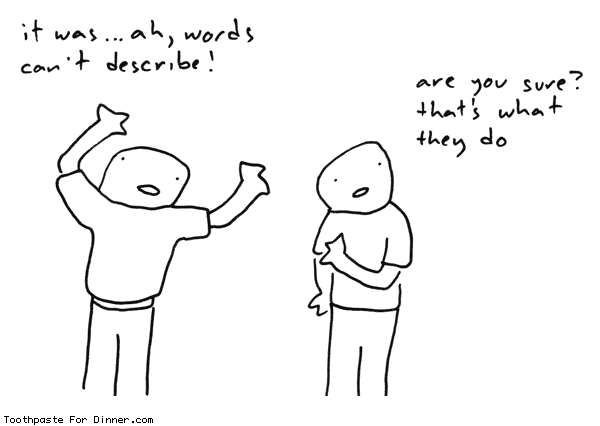
Ahh, toothpastefordinner.com ...providing me with cartoons to illustrate my point when words won't do. (IRONY!! THIS IS ACTUALLY IRONY!! I DID IT! I RECOGNISED IRONY IN A SITUATION.)

Previously in my blog, I wrote about vocabulary explosions. Today, because I want to, I'm going to write about how I'm learning new vocabulary in Welsh.

The main thing I like to do is to read the BBC news in Welsh . The BBC have a really cute app on their site that allows you to hover over words that are highlighted in yellow to get a quick translation. I like to do this in the morning while I drink tea and look out at my balcony with the dead plants because I'm posh like that.

I pick four or five words from an article, and plug them into my Anki SRS flashcard app on my phone. (My phone is quickly becoming a language learning dream. More on that later, perhaps.) SRS stands for Spaced Repetition System, by the way - it's intended to make sure that you only practice a word "right before" you're about to forget it, but that's debatable - I think of it as basically a way of practising hard words more frequently and easier words less frequently.

I try and go through my flashcards every day, and it only takes about five minutes, so no biggie there.

Anki also helps me remember what words I want to remember, if that makes sense - I'm reminded to use some of this new vocab. Well, that's the idea anyway, though I usually don't use a word straight away, unless I'm very deliberately going to be talking about a particular topic. What I've found instead is that I start using a new word after I hear someone else say it  - maybe that's the last bit of the learning process that cements the word.

I also get new vocab from skyping in Welsh - usually by the end of a conversation I'll have at least half a dozen new words that I've asked to have spelt for me, and I put them in the Anki app as well. I've started downloading some Welsh flashcards for my Memrise app, but I'm not sure about that yet.

I don't get much vocab from listening to Radio Cymru, to be honest - usually because I listen to it in the car and then I forget the word before I have time to look it up.

....and this is an awkward end to a blog post.


Saturday, 23 November 2013

on vocabulary explosions

As we aaaaall know, toddlers are linguistic geniuses who learn like 3000 new words every day whereas adults are veritable cretins who can't string two words together in another language to order a cup of coffee. (There were extenuating circumstances; I didn't know it was culturally weird to order a takeaway coffee in Italy; it all went downhill from there.)

Thing is, I don't think this is entirely true. Okay, yeah, most kids have the kind of capacity to pick up language subconsciously that makes the slow, laborous task of adult language learning seem, well, slow and laborous - except that actually I think we get a few breaks along the way.

I've been thinking about how much easier (easier? really? am I allowed to say that? it's a relative term; it's staying) it is for me to pick up Welsh vocabulary now than when I first started learning the language.

(People like to complain about Welsh mutations (treigladau), and sure, they're fun, but I just wish every word in the Welsh dictionary didn't start with a 'c'.)

As a totally unscientific observation, the more vocabulary I learn, the quicker I pick up new vocabulary. I have a few ideas why this might be so:
  • Words are related. When you can start to pull words apart - with prefixes and suffixes and the like - and you can see how those parts are put back together, suddenly it's not so hard to remember that anghyfreithlon means 'illegal' when you've seen the 'freith' bit in other words relating to law, and the 'ang' bit in other negative words, and the 'lon' bit in adjectives or whatever they're called
  • Improved memory capacity/capability. Just throwing it out there. Right? I'm sure you improve your ability to remember things the more you use it. I read that somewhere, I just can't remember where. (ha ha.) But seriously, they (whoever "they" are) talk about neuroplasticity as something that continues throughout your lifetime and is not just the magical elixir of screaming three year olds so probably right now I am forcing my brain to make new neural pathways that are better able to retain new vocabulary - albeit at a slower rate than when I was a kid.
  • More accessible grammatical structures within which to put your new vocab. Legit. What I mean is that through practising other language stuff, like grammatical structure, I get better at those things which means that when I'm speaking Welsh, I use less mental resources on trying to put a sentence together which frees up some room in my brain to dig up some new vocab.
Is adult vocabulary explosion a real phenomenon? If so, what other reasons might there be for it? How do we optimise it and stuff?

Monday, 18 November 2013

Linguistic Real Estate

or, the logistics of learning two languages at once.

So this is my metaphor for learning a language.

You start with a handful of words and a smattering of grammar, and you build yourself a little mud hut that may or may not survive an unexpected sneeze, let alone the winter. But slowly - or quickly - you build up this crappy little mud hut until it becomes a kind of granny flat, and then a tiny one by one house, and then when the foundations are a bit stronger you kind of start adding rooms with new areas of vocabulary and suddenly there's a whole new gable of the pluplerfect subjunctive blah coming off one side and you're doing a bang up job of decorating that place with all sorts of cute adjectives and expressions and everyday slang.

Linguistic real estate, right?

But as home owners know, when do you ever stop? You don't stop. It's never finished. You'll be doing home renovations and touch up jobs for the rest of your life, if you let yourself.

The question is, then, when do you redirect some of the energy you're putting into beautifying this one piece of lingustic real estate, into a whole nother pile of sticks and mud? Can you work on both places at once? What if you put all your energy into this new shack of language and then you go back to your old place and now your interior design is so last year and also the whole west wing has collapsed because your supporting wall wasn't that supporting after all?

Okay, enough with the analogies, you get the picture.

So here's my problem in real terms. I'm feeling pretty good about my Welsh ar hyn o bryd. I can have an interesting conversation without relying too heavily on English and without asking for every second word to be repeated (just every third) so long as my conversation partner is... talking... like... this... I mean, I really feel like I've come a long way. I'm even sometimes starting to think of myself as bilingual (NO WHAT? ADDING THAT to the list of things to blog about).

And now I'm starting to dip my toes into Lithuanian (there's a reason, legit) but I don't want to stop learning Welsh but I'm not sure I can do both at once or you know, hey, how do I do this?
  • is there a point where I can say "yup, my Welsh is at this level and this is a good place to take a breather"?
  • can I learn two languages at once?
  • if so, how?
  • do I study them on different days of the week? different settings? one at home and one at work? (no I don't sit at my desk going through vocab what who said that?)
  • do I even have the energy to start over with a swamp hut?
  • what if one language inteferes with the other?
Answers on a post card, please.