Showing posts with label cymraeg. Show all posts

Monday, 23 December 2013

Kaip jus gyvenate?

How you doing?

Yup, I've stuck my toes into the water, and am having a little splash around with Lithuanian.

(Already I can see I'm going to need to learn how to use diacritics and stuff if I want to blog properly about this, because that 'u' in 'jus' should have a line above it. Help?)

I'm using a podcast series called Lithuanian Out Loud and I'm just going to go right ahead and compare it to Say Something In Welsh because - well, my opinons and comments about this series only make sense in the context of having done SSiW, I think.

Okay.  

Things I like about Lithuanian Out Loud
  • the introduction to each lessons includes some cultural background about Lithuania. I think if you've never been to the country (I certainly haven't) and you're just starting to get into the language media, it's nice to see the language you're learning as part of some cultural context. I know the aim of SSiW is to get you speaking the language as soon as possible and time spent discussing the amber trade (or whatever equivalent) is time wasted on that objective - but, I do appreciate this about Lithuanian Out Loud
  • (can I abbreviate it to LOL?)
  • The lessons follow the more usual structure of starting with 'hi, how are you doing?' and so on. In some ways not the most useful thing to know because you only get to say it once to a person; but then I found with SSiW that I wasn't necessarily prepared to make all those pleasantries in conversation (even though I could then tell you very interesting things about what I was thinking or learning or reading)
  • There are 'quick response' episodes every five lessons - nowhere near similar in scope to SSiWs all-quick-response-all-the-time approach, but at least LOL has something along those lines, so after I've finished lacadasically listening to the other lessons, I can do a quick assessment of what I know and what I need to practice
  • I'm enjoying the extra focus on grammar (any focus on grammar is "extra" focus on grammar compared to SSiW :) ) because actually I just enjoy grammar. It's not going to help me speak, but it's interesting to learn

Things I don't like about Lithuanian Out Loud
  • It's so slow!! Oh my gosh, I did an hour's worth of lessons this morning and by the end I knew how to conjugate the verb 'gyventi' (to live) - which doesn't even mean I can actually use those conjugations in speech. By the end of an hour of SSiW I'd be - well, I'd be unconscious, and then after I woke up I could tell you about twenty different things I'm doing right now.
  • I mentioned I like the cultural background; but it also means I have to sit through that stuff again to get to the practice part of the lessons. (See: It's so slow!!)
  • Even with the quick response episodes, there isn't much speaking practice. I'm learning - studying? - a language here, not acquiring it
What I'm going to do

I'm still going to use Lithuanian Out Loud as my base for learning Lithuanian - it's an extensive course that continues to have new lessons added, so that's pretty awesome. And because LOL follows a more common language course structure, I'm going to do it with a critical eye, see what I like, see what I don't like - that's good information there, I think, for teaching languages.

But I'm going to add some extra elements that I've found really helpful for learning Welsh (and which aren't actually part of SSiW either). I'm going to do my spaced repetition cards for practising vocab and stuff on the fly (because I just like them), and I'm going to tee up some conversational practise for Lithuanian much much sooner than I did for Welsh. I think it was seven or eight months before I had a real conversation yn Gymraeg, and it made such a difference. I might not go for the 'speak from day 1' approach exactly with Lithuanian - I still want some vocab and structures under my belt first - but definitely no more than two months, say?

Sunday, 22 December 2013

Y Llinell


"If tired, servile and scared First Minister Carwyn Jones represents what Wales currently is.
Then this is what we should aspire to be – an unstoppable force running like a nutter through the streets of Aberystwyth to the sound of Genod Droog."
(http://www.welshnot.com/culture/music/genod-droog-breuddwyd-oer/)


Saturday, 21 December 2013

Staring at the sea (staring at the sand)

Generally people say that learning your third language is a lot easier than learning your second. I guess there are a few reasons for this: better understanding of language structure, gained experience in how to learn another language, and increased confidence, for a start.

I totally agree with the first two reasons but I have a few quavering doubts about the third, “increased confidence”. Like definitely when you’re just starting to learn a second language, it's like staring out at this vast ocean and you have no idea how to navigate it or how long it will be before you get your feet on dry land and is your boat even seaworthy? You know.

(image: carolyncochrane.com)

When you’ve got a fair bit of your second language under your belt, though, it’s like “oh, okay, I've learnt how to row and I can see land and being able to hold a conversation in another language is actually possible.” So that’s a confidence booster, right?

Thing is... I know how hard I worked to get my Welsh to a stuttering, faltering, just-about-able-to-have-a-conversation level. Like, I worked hard. I mean not Benny the Irish Polyglot hard but at the point where you're doing two or three hours a day – including lessons, listening to the radio, watching a bit of Welsh telly, and reading the news in Welsh – it's super fun but also mentally exhausting.

Learning a language is possible, it’s worthwhile, and a lot of the time you feel like a horse in a glue factory. I'm not exactly sure I have increased confidence here.

So I’m standing on the beach, staring out at this expansive ocean of Lithuanian (I probably won’t push this analogy much further, don’t worry), and I know I can manage it, but also it’s nice to feel steady on my feet, and I want to rest here a bit more.

Monday, 2 December 2013

Why Welsh III

Iawn te. Wedais i oedd mwy o resymau pam dw i'n dysgu Cymraeg, felly dyma ni.

Right then. I said there were more reasons why I'm learning Welsh, so here we are.

(Straight away I feel I should apologise profusely and point out that I don't regularly write yn Gymraeg so I think this is how I would write the above sentence; but possibly also how I would say the above sentence is wrong too.)

One of my curiously favourite things about Welsh which also sounds quite sadistic/patronising is that it's very much one of those minority languages the linguists are always going on about; and being (or having been) one of "the linguists", I'm all over that like a cat on a fly screen door.

According to UNESCO, who rate endagered languages from "vulnerable" to "critically endagered" based on the transfer of the language intergenerationally, Welsh is considered "vulnerable". This means that while lots of kids speak the language they don't do it across all areas of life. There are other figures out there of course, about the number or percentage of Welsh speakers in Wales and globally, but in the end if children don't speak the language then it will die out in a couple of generations.

Language revitalisation: one stinky, baked-beany, book-eating kid at a time (image: www.walesonline.co.uk)


This isn't a morbid fascination I have with a dying language though - it's a giddily optimistic eagerness to see a language kick ass and take names, and as a Welsh language learner I get to see this not just as a passing spectator but ever ever so slightly from the inside. I have something invested in this.

I think partly my interest comes from being a bit of a sap - I cry (bawl) when the ugly person on a talent show has the best voice, or the soldier's dog goes crazy over its owner's arrival at the airport, or the overworked single mum of five comes home from work one day to find Oprah has renovated her entire house and also here's a new car and a holiday. You know, that sort of thing. GO LITTLE LANGUAGE GO.

But I also have a slight but weird political bent (I'm sure I get this from my dad), in the sense of being interested in policies and people.

I love the idea that government has the potential to create policies that will have a positive impact on people's lives. For example, the Welsh Government/Llwyodraeth Cymru has its "Welsh Language Strategy 2012 - 2017" (which you can read here as a 53 page pdf). I think there is unfortunately already some backpedalling on this about whether certain targets will be met by 2017 and who's responsible for it, but that's part of the political game. (Even though it sucks. Which it does. But it makes victory sweeter, right?)

Following the Welsh political/language scene also throws a very interesting light onto the upcoming vote for independence in Scotland. Maybe it won't happen this referendum; it may happen the next. I'm guessing Scotland will have to do it before Wales does, and then what a game changer for Wales if when they become independent.

Of course rising to meet the challenge of the apparent hopelessness of the Welsh government to create any kind of positive language change (that may be hyperbole; I don't know. I write because I'm ignorant, innit) are the "grassroots organisations", by which I mean people.

People like the folk at Say Something In Welsh, the Welsh language course I'm doing (and a reason in itself to stick with the language), and FfrinDiaith (hosted at the SSiW website), who help language learners to link up with language speakers. I believe very strongly in what these people are doing and they give me a lot of hope for the future of Welsh.

So I'm very much looking forward to see how all these things interact and keep on interacting and growing to essentially rework the future of a language (and a nation?); I don't for a second believe that as a twenty-something year old living in Australia I can positively influence that change but nevertheless by learning Welsh I get to see that change as something that influences me and that's pretty cool.

Friday, 29 November 2013

on bilingualism

Those of us who haven't grow up speaking two languages I suspect have all asked ourselves the question "when do I get to call myself bilingual?"

I think this is a very personal question with as many answers as speakers and it's also something that's very important because ultimately we're not just asking about our skill level - we're asking about our identity.

My guess is that ~adult language learners who are primarily learning the language with the hope of one day speaking it - and this includes the majority of high school language learners - have a very high standard of what it means to be bilingual. I speak my first language with this level of (quite frankly extravangant) competency and ease; I can only be bilingual when I speak my second language with the same comptency and ease.

And this is a legit definition of bilingualism because isn't it basically what people who are bilingual from birth (or near enough) do?

Well, maybe. Without doing any empirical research whatsoever or even checking wikipedia I'm pretty sure that lots of bilingual-from-birth-ers do not actually speak both languages equally well. One language gets stronger from being used more often; one language has been used for academic things; one language is spoken with lots of code-switching to the other; etc.

Personally, I would love to be as fluent in Welsh as I am in English - which, let's be honest, is not exactly a perfect level of fluency at the best of times, let alone when I'm tired or excited or a little bit tipsy or wearing new shoes or its raining or I need to go to the toilet.

Nevertheless I am nowhere near that level of perfect dysfluency in Welsh. But, shortly after I came back from The Big Welsh Holiday Of 2013, I decided that I had had too many interesting conversations about a range of topics - regardless of how slowly I spoke, how slowly I was spoken to, how many repetitions I needed, or how many words I fudged - to not call myself bilingual.

My idea of what I considered necessary for bilingualism is different because I have been able to focus on "communicate now" rather than "speak one day".

I think of course there are some situations where you can sort of measure how fluent you are in your second language and there's a standard to be attained - for example, getting a job in your second language, or passing a particular language exam. But if you aren't fluent enough for that standard, it doesn't mean you're not bilingual - it just means you aren't fluent enough for that standard. (Yet.)

You can be bilingual with just a few words in your second language. I work with kids who are considered bilingual and who are pretty rubbish in both their langauges, and that's absolutely fine and it's also really important to acknowledge that they are still bilingual.

I think something happens when you call yourself bilingual - I'm not sure what yet, but it has something to do with how long some of us have been wanting to speak a second language and how it feels to be suddenly a member of the non-monolingual world and how important language is to our lives and given that importance, how we now see our linguistic identity.

So kids, when do you get to call yourself bilingual?

Thursday, 28 November 2013

Why Welsh II

Yesterday I wrote briefly about my reasons for starting to learn Welsh - I like learning languages, and also I wanted to go to Wales for a holiday.

(By the way, I thought I would write less frequent, longer posts, but I think I might have a go at writing more frequent, shorter posts. Not that it matters to my readership of one (my mother). So we'll see how this goes.)

But as people have objected - "they speak English in Wales, don't they?"

This is true; I think you'd be hard pressed nowadays to find a single speaker of Welsh in Wales who didn't also speak English. Of course if you went to the Welsh settlement of Y Wladfa in Patagonia, Argentina, you may find Welsh speakers who do not in fact also speak English, but Spanish. Ha! So in that instance, if you didn't speak Spanish but you did speak Welsh, you would be thinking "what a useful language this is".

"What a pretty flag this is" - Y Wladfa flag


But yes - primarily Welsh speakers in Wales also speak English, so what's the point?

The point is that both English and Welsh are - officially - the national languages of Wales, and that Wales is its own country. It's not actually England. I mean, duh, but although Wales and England have been very much intertwined after centuries of British colonisation and post-colonisation, in perfect theoretical and ideological terms Welsh is absolutely as important as English.

Learning tipyn bach o Gymraeg before going on holidays to Wales is a way of recognising that Welsh is an official language of the country. To me, it's a socio-political statement. It's a sign of respect.

I realise that may sound incredibly patronising for reasons I can't quite put my finger on and to be honest, I didn't get to speak that much Welsh in Wales (other than meeting up with other learners), so my respect doesn't count for tiddly beans. But I made an effort to start most of my interactions with shw mae and end them with diolch and on a couple of occasions the person definitely did a double take before answering croeso, and I feel like in that tiny way I had been able to also say, you know what, this language matters. Your language matters.

Because obviously that's what this is all about, me feeling good about making you feel good - oh, there it is, that's what makes this patronising. Oh well.

Guess what? That's not even the last good reason I have for learning Welsh! There's more!

So, what do you think? How important would it be to you to learn a minority language in a bilingual country? How do you see minority languages in bilingual nations? How about Welsh national independence, huh? Ooh, now there's a can of worms...

Wednesday, 27 November 2013

Why Welsh?


When people ask why I'm learning Welsh, I think I brace myself a little inwardly, knowing that whatever answer I give will never be quite the right answer - they will nod, and smile, and say “Yes, but why?”

In all honesty, there wasn't much thought to it in the first place; but much like I started being vegetarian because I wanted to be cool like my sister who was vegetarian and then later on found lots and lots of other (actually good) reasons to be vegetarian, I now have a swag of reasons to learn Welsh - so let's try and answer this question for good, shall we?

The first thing I usually say is "Well, I really like learning languages" or "Wel, dw i really hoffi dysgu ieithoedd" depending on who I'm talking to. I think this is supposed to make me sound like some amazing polyglot with language notches all over my belt, but what I actually mean is I've got a long line of failed failed failed language learning attempts and forays behind me - including Indonesian, French, Italian, Chinese, Estonian, Lithuanian, Bundu Dusun, Spanish, Autralian Sign Language, and the lyrics to Sich Offnen by Australian indie rock band 'Not From There' (so, German?) - so at least the idea of having a crack at Welsh wasn't completely out of left field.

For people who don't buy "I want to learn it because it's there" as enough reason in itself - which is most people - I then add that I was planning a holiday to Wales so why not learn a bit of Welsh?

(Apaprently some people need a reason for that as well - really? have you seen Wales? Why would you not want to go on holidays there? But then I mess things up by saying I wanted to go to Wales because I was learning Welsh, and it all gets very chicken and egg.)

DO YOU WANT TO BE HERE YES/YES? (Criccieth at sunrise, by me.)
This is legit as far as my own thought process went before I was downloading some Welsh podcasts and dreaming of fluency. I like talking; I want to go to Wales. Okay then.

Of course the obvious objection to "I'm going to go to Wales so why not learn a bit of Welsh?" is "but everyone in Wales speaks English right?" That's when it gets very interesting and very political, very quickly. And that is the subject for another post.

Sunday, 24 November 2013

how do you word?

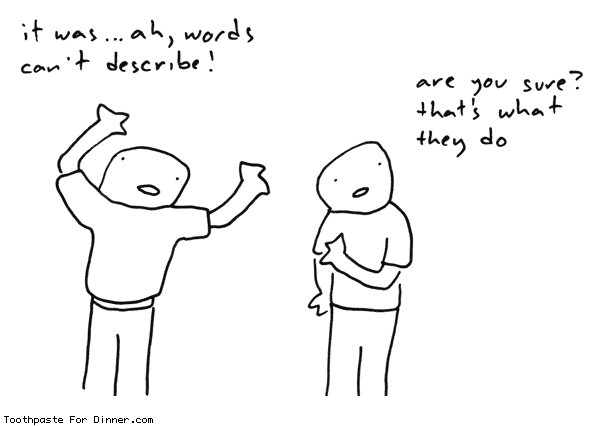
Ahh, toothpastefordinner.com ...providing me with cartoons to illustrate my point when words won't do. (IRONY!! THIS IS ACTUALLY IRONY!! I DID IT! I RECOGNISED IRONY IN A SITUATION.)

Previously in my blog, I wrote about vocabulary explosions. Today, because I want to, I'm going to write about how I'm learning new vocabulary in Welsh.

The main thing I like to do is to read the BBC news in Welsh . The BBC have a really cute app on their site that allows you to hover over words that are highlighted in yellow to get a quick translation. I like to do this in the morning while I drink tea and look out at my balcony with the dead plants because I'm posh like that.

I pick four or five words from an article, and plug them into my Anki SRS flashcard app on my phone. (My phone is quickly becoming a language learning dream. More on that later, perhaps.) SRS stands for Spaced Repetition System, by the way - it's intended to make sure that you only practice a word "right before" you're about to forget it, but that's debatable - I think of it as basically a way of practising hard words more frequently and easier words less frequently.

I try and go through my flashcards every day, and it only takes about five minutes, so no biggie there.

Anki also helps me remember what words I want to remember, if that makes sense - I'm reminded to use some of this new vocab. Well, that's the idea anyway, though I usually don't use a word straight away, unless I'm very deliberately going to be talking about a particular topic. What I've found instead is that I start using a new word after I hear someone else say it  - maybe that's the last bit of the learning process that cements the word.

I also get new vocab from skyping in Welsh - usually by the end of a conversation I'll have at least half a dozen new words that I've asked to have spelt for me, and I put them in the Anki app as well. I've started downloading some Welsh flashcards for my Memrise app, but I'm not sure about that yet.

I don't get much vocab from listening to Radio Cymru, to be honest - usually because I listen to it in the car and then I forget the word before I have time to look it up.

....and this is an awkward end to a blog post.